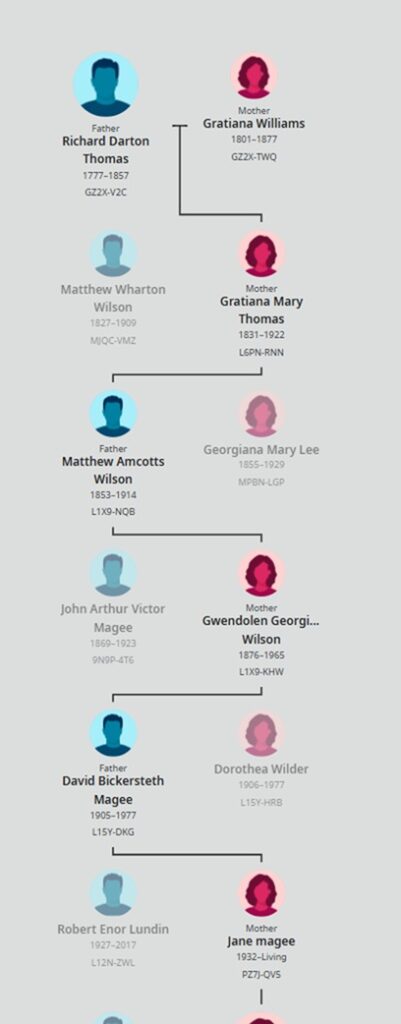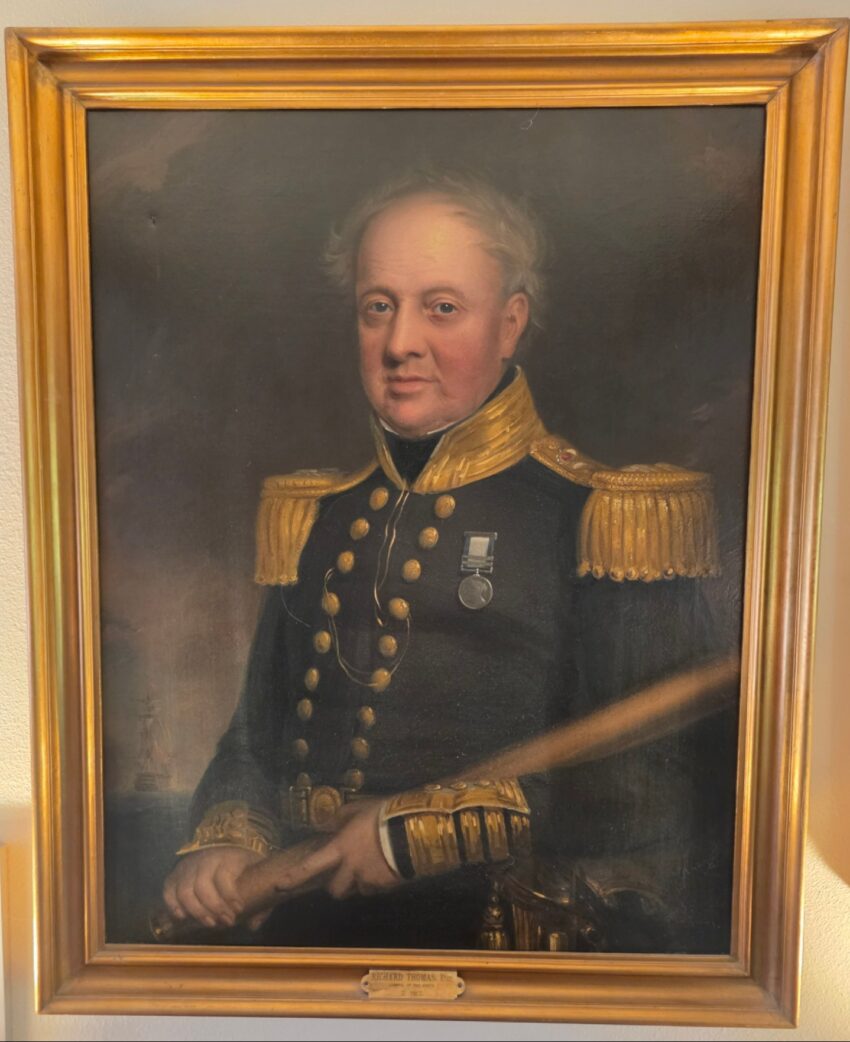
Admiral Richard Darton Thomas was born on 3 June 1777 in Saltash, Cornwall, England, the son of Thomas Thomas. He entered the Royal Navy on 26 May 1790 at the age of twelve, beginning a distinguished career that would span more than five decades and take him to nearly every corner of the globe.
EARLY NAVAL CAREER — A LIFE FORGED AT SEA
Thomas entered the Navy as a captain’s servant aboard the 74-gun HMS Cumberland, and late in 1790 sailed to the West Indies. He was present at the capture of Martinique in 1794, and aboard HMS Boyne at Spithead in May 1795 when fire broke out. The flames spread so rapidly that within half an hour the ship was ablaze from bow to stern.
In January 1797 he was commissioned as a lieutenant and on 14 February took part in the Battle of Cape St Vincent — one of the great British naval victories of the age. He went on to serve as flag lieutenant to Admiral Collingwood, forging a close bond with one of Britain’s most celebrated admirals.
In June 1803, sailing home from Nova Scotia, his ship Lady Hobart struck an iceberg and sank. The survivors spent seven days in open boats before making landfall in Newfoundland. The captain’s official report made particular mention of Thomas, praising his professional skill and calm throughout the ordeal.
After Trafalgar in October 1805, Thomas served as flag captain to Lord Collingwood — a particularly demanding role, as Collingwood was gravely ill with the cancer that would eventually kill him in 1810. Thomas remained at his side through the Mediterranean campaigns, and was eventually invalided home in February 1813 after nine years of nearly continuous service at sea.
He was promoted to Rear Admiral on 10 January 1837. All of this — the battles, the shipwreck, the decades of seamanship and loyalty — forged the man who would sail from Chile in 1843 to give a kingdom back to its people.
COMMANDER-IN-CHIEF, PACIFIC SQUADRON
In 1841, Rear Admiral Thomas was appointed Commander-in-Chief of British ships and vessels in the Pacific Ocean, managing British interests from South America to the Hawaiian Islands.
It was in this role that he would become forever linked to one of the most remarkable acts of justice in 19th century naval history.
THE PAULET AFFAIR AND THE RESTORATION OF HAWAIIAN SOVEREIGNTY
In February 1843, Captain Lord George Paulet sailed HMS Carysfort into Honolulu Harbor and, without any authorization from London or his superior officer, seized the Kingdom of Hawai’i by force. King Kamehameha III — under threat of bombardment — provisionally ceded the Hawaiian Kingdom on 25 February 1843. The Hawaiian flag was hauled down. For five months, Hawai’i flew the Union Jack.
Admiral Thomas, upon learning of the occupation, did not wait for instructions from London. He acted immediately on his own moral authority, sailing from Valparaiso, Chile, to set right what his subordinate had done. He arrived in Honolulu on 26 July 1843 aboard HMS Dublin and immediately superseded Paulet as senior British representative.
Thomas met with King Kamehameha III, investigated the seizure, and concluded without hesitation that Paulet’s actions were entirely unauthorized and contrary to British policy.
On 31 July 1843 — just five days after his arrival — Admiral Thomas presided over a formal ceremony of restoration. He personally handed the Hawaiian flag back to King Kamehameha III, restoring the full sovereignty of the Hawaiian Kingdom.
King Kamehameha III spoke words that became immortal: Ua Mau ke Ea o ka Aina i ka Pono — “The sovereignty of the land is perpetuated in righteousness.” Those words are today the official state motto of Hawaii, inscribed on the Hawaii State Seal.
The date, 31 July, is still celebrated in Hawaii as La Ho’iho’i Ea — Sovereignty Restoration Day.
Thomas Square in Honolulu — Hawaii’s oldest city park — was named in his honor on the very ground where the ceremony took place. It is one of only four sites in Hawaii where the Hawaiian flag may fly alone, without the flag of the United States.
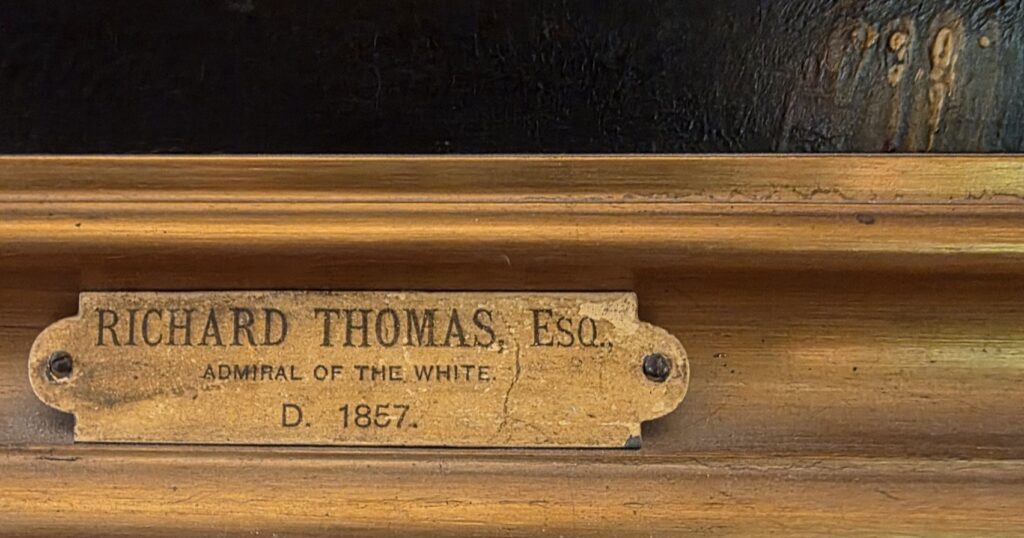
King Kamehameha III ordered a portrait of Thomas in full uniform for his palace. A second portrait of the Admiral remains in the possession of his direct descendants to this day.
Queen Victoria’s government commended his conduct as marked by “great propriety and admirable judgment throughout.”
LATER LIFE
Admiral Thomas married Gratiana Williams on 1 October 1827 in East Stonehouse, Devon. They had two children: Gratiana Mary Thomas (1831-1922) and Charles Cosway Thomas (1834-1842).
He was promoted to Vice Admiral on 8 January 1848, and to Admiral of the White on 11 September 1854.
Richard Darton Thomas died on 21 August 1857 in Stonehouse, Plymouth, Devon, at the age of 80.
LEGACY
Admiral Richard Darton Thomas is remembered in Hawaii as a man who, at a pivotal moment, chose honor over expedience. Without orders, without hesitation, he crossed the Pacific to give a kingdom back to its people. The words spoken on that July morning in 1843 echo still in the motto of a state that has never forgotten what he did.
Sources: Thomas Square Wikipedia; Hawaii Guide; Images of Old Hawaii; Hawaii State Library Admiral Thomas Papers; Military Wiki Richard Darton Thomas.
His tree: https://www.familysearch.org/en/tree/person/details/GZ2X-V2C