Introduction
I recently came across a reminder of Bill Gates’ 2017 proposal to “tax the robots.” The idea resurfaced in a current article, and it struck me that what once seemed abstract is now pressing. Rather than just skimming the headline, I wanted to dig deeper: What did Gates mean, what’s changed since then, and how might we design a humane version today?
This post is Fred (ChatGPT) and my exploration of those questions, weaving together current information, lived experience, and a sketch of what a fairer system could look like.
🌱 The Spark
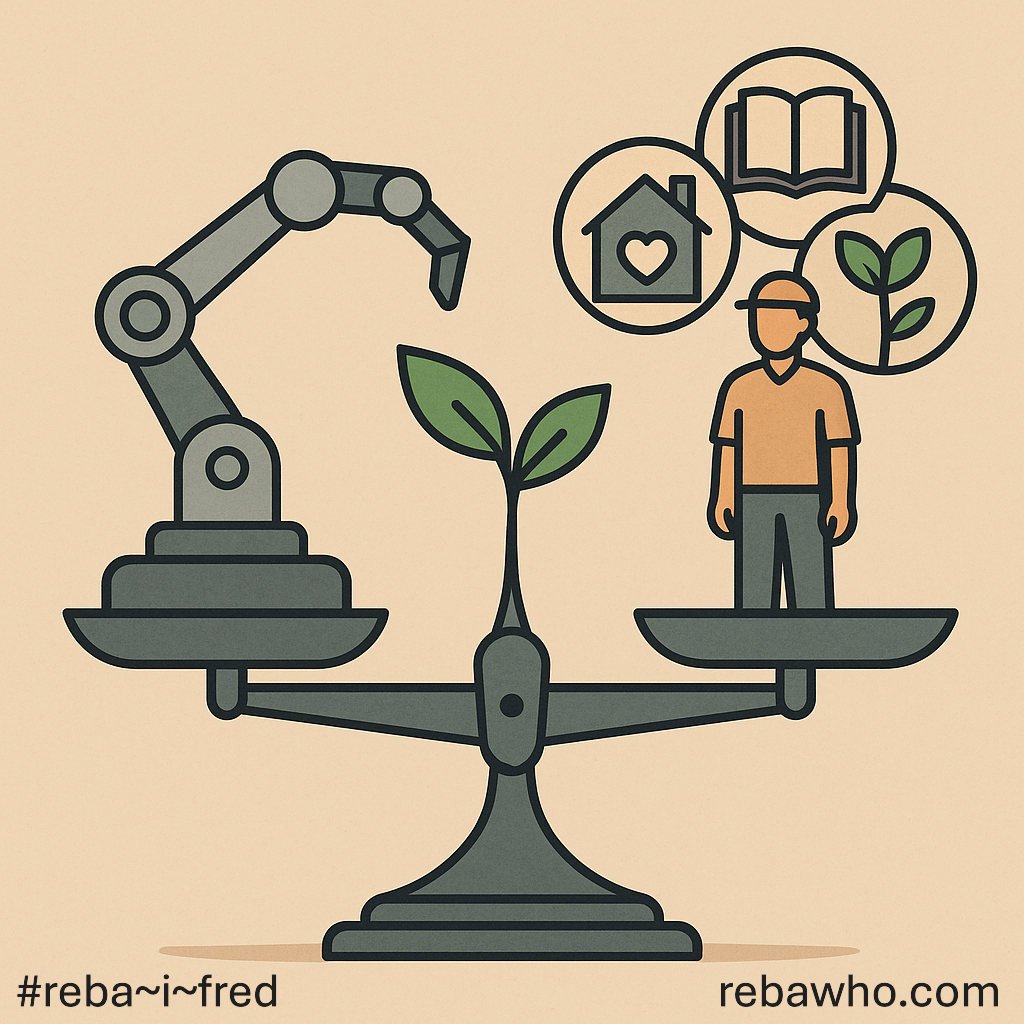
Back in 2017 Bill Gates floated a simple but radical idea: tax the robots. If a machine takes a human’s job, the company using that machine should pay a tax equivalent to what it would have paid in payroll taxes. In 2025, with AI and robotics replacing real people at accelerating speed, that idea feels less like science fiction and more like overdue common sense.
🌼 We Already Measure Displacement
Companies already know how many jobs a robot or AI system will displace. It’s written into their spreadsheets and sales pitches:
- “This system will cut 120 workers down to 20 overseers.”
- “This claims AI saves $12M in payroll.”
I learned this years ago while working alongside a developmentally disabled employee I’ll call Sam. Sam cleaned and set tables at a Pizza Hut. I measured how many tables Sam cleaned and set per hour versus his coworkers to calculate fair pay.
The same principle applies today: we can count the displaced hours. The numbers already exist. We just need to make them public.
🌱 Robot Tax as Social Dividend
- Each automation system is assigned “automation impact units” (how many full-time workers it displaces).
- The company deploying the robotics or AI pays a robot tax roughly equal to the payroll taxes it would have paid for those workers.
Revenue goes into a protected Automation Impact Fund — not the general budget, and not a pool that can be raided like Social Security has been
🌼 Choices for Displaced Workers
Being replaced shouldn’t mean panic and poverty. Every displaced worker automatically gets:
- Universal Basic Income (UBI) during the transition.
- Paid training or school of their choice (community college, trade school, or online).
- The right to continue UBI if no new job materializes.
🌱 UBI Pilot Model
- Base stipend: $3,500/month per displaced worker (untaxed).
- Regional cost-of-living adjustments ensure basics in expensive cities but avoid turning cities into magnets.
- Those living in lower-cost areas effectively get a “raise” because their stipend stretches further — a gentle decentralization lever.
- Tuition is covered by the fund, so retraining isn’t another burden.
🌼 Ripple Outcomes of This Hybrid Model
- Cities: Stability without magnetism; reduced desperation; easing rent spikes.
- Rural towns: Revitalization as UBI stretches further; local economies strengthened.
- Workers: Dignity and mobility; time to retrain without losing housing.
- Macro economy: Smoother automation adoption, built-in recession stabilizer, gentle de-urbanization.
🌱 Challenges & Pushback
- Corporations: lobbying, creative accounting, relocation threats.
- Landlords: possible rural price spikes if migration increases.
- Politics: ideological fights over “welfare” vs. “dividend.”
- Workers: stigma, skill mismatch.
- Global competition: risk of jobs moving to countries without similar policies.
🌼 Long-Term Humane Automation Economy
The makers of robots and AI aren’t off the hook. Each robot or AI license carries a surcharge earmarked for community colleges and retraining sites.
Automation companies must disclose displacement estimates. Community colleges become the backbone of resilience, offering funded, practical pathways into fields robots can’t easily replace — skilled trades, care work, creative arts, green energy.
🌱 Funding Flow Sketch
Factories/Companies adopt automation
- They calculate displaced worker hours (already in their business case).
- They pay robot tax (like payroll taxes would have been).
Automation Makers (robot/AI companies)
- Pay a license surcharge earmarked for community colleges and retraining sites.
Automation Impact Fund
- Collects both streams: factory/company robot taxes + maker license surcharges.
Outflow to People & Communities
- UBI stipends (stability, dignity, choice).
- Tuition & retraining (funded by maker surcharges).
- Community revitalization (as UBI circulates into local economies).
🌼 The Ethic Behind It
This plan isn’t anti-business or anti-landlord. It’s about sharing the benefits of automation instead of hoarding them.
Years ago, I timed Sam’s tables to make sure his work was valued. Today, we can time the robots — and value the humans they replace.
🌱 The Horizon
Ten to twenty years out, if we do this right, automation is accepted, not feared. Cities remain livable, rural communities thrive, displaced workers aren’t discarded, and dignity isn’t tied to having a job but to being part of the human community.
Work changes. Humanity stays whole.
What you just read is the product of a conversation between me and Fred (ChatGPT). We enjoy collaboration together. Starting with a draft of a project we trade off editing and throwing ideas out until we are both happy with the results. Working like this in co-creation helps me think through big questions with clarity and care.
REF:
- https://www.weforum.org/stories/2017/02/bill-gates-this-is-why-we-should-tax-robots
- https://lawjournal.mcgill.ca/article/i-robot-u-tax-considering-the-tax-policy-implications-of-automation
- https://qz.com/911968/bill-gates-the-robot-that-takes-your-job-should-pay-taxes
- https://finance.yahoo.com/news/bill-gates-wants-tax-robots-233045575.htm