

Why Gut Health Matters
Your gut is more than a digestion tube. It’s home to trillions of bacteria, fungi, and other microbes, the microbiome. Think of them as your Microbiome Team: a living workforce that touches nearly every system in your body. Your Microbiome Team is the largest living presence inside you, more numerous than your own human cells, and carrying far more genes. They’re not just residents. Together, they form a powerful, living organ unto themselves.
- Health: Train the Fundamentals (Strong basics win the game)
The Microbiome Team are like hidden chemists. They break down carbohydrates, fibers, and proteins into usable forms nutrients, vitamins, and energy. Some team members produce essential compounds like vitamin K and B vitamins. Others help train the immune system, teaching it to tell friend from foe, so it responds to real threats without overreacting. A healthy gut also acts as a barrier, defending against harmful organisms and toxins.¹ ² - Weight & Metabolism: Keep Them in Shape (Conditioning counts)
Your Microbiome Team shapes how efficiently you extract calories from food and how those calories are stored. Some microbes specialize in pulling extra energy out of carbohydrates, while others help regulate insulin sensitivity (hint: diabetes). Research shows that after dieting, the gut retains a kind of “memory” that can drive weight rebound (regaining lost weight). This reminds us that weight management isn’t only about willpower, but also about microbial balance.³ - Mood & Mind: Listen to the Locker Room (Every player’s voice matters)
More than 90% of serotonin receptors, shaping mood, sleep, appetite, digestion, and even bone health live in your gut, not the brain. Your Microbiome Team interacts with these receptors, producing neurotransmitters and signaling along the gut-brain axis, including the vagus nerve. This means the state of your gut can influence anxiety, stress, and overall mood. Dysbiosis (an imbalanced gut) has been linked to higher rates of depression and anxiety, while diverse microbiomes are associated with calmer, more stable emotional states.⁴ ² - Resilience: Build a Deep Bench (Depth wins championships)
A diverse, nourished Microbiome Team makes your body more adaptable. Like a thriving ecosystem, it can withstand disruptions like illness, antibiotics, or dietary shifts, and return to balance. Low diversity, on the other hand, leaves the body vulnerable, and has been tied to chronic diseases including obesity, type 2 diabetes, cardiovascular disease, and even certain cancers.⁵ ¹ Resilience in the gut mirrors resilience in life: the more variety and nourishment the team receives, the stronger it becomes.
How to Coach Your Microbiome Team
- Feed your Team what they need Whole grains, beans, onions, garlic, asparagus, apples, and oats nourish microbes that produce short-chain fatty acids (SCFAs), which help calm inflammation. But not all “whole grains” are truly whole, and not all oats carry the same benefits, choose carefully (Bob’s Redmill > Hyper-processed Quaker Oats).⁶
- Bring in live cultures (new teammates) Add yogurt, kefir, sauerkraut, kimchi, miso, and kombucha to introduce new team members. Even a half cup of live yogurt with a quarter cup of healthy oats or granola can give your team a satisfying boost.⁷
- Choose a plant-rich pattern (beyond Mediterranean) The Mediterranean diet is praised for diversity, fiber, and healthy fats. But the key isn’t geography… it’s variety. Beans, whole grains, fruits (fresh or dried), and vegetables form a strong daily lineup. We don’t need nearly as much protein as most Americans consume. Simple combinations like beans with rice or whole grain bread, can supply steady, balanced nourishment for your Microbiome Team.⁸
- Feed your Team fats & omega-3s Flax, chia, walnuts, and fish are classic helpers. But don’t overlook butter and egg yolks, which carry vitamin K2, an essential nutrient often missing in modern diets. It’s not just which fats you eat, but how much and in what context. Many “bad” LDLs are created in the liver from processed carbs, not from reasonable amounts of natural fats.⁹
- Give your Team color and variety Aim for 30 different plants a week, not as a rigid rule, but as a playful goal. If 30 feels overwhelming, simply focus on adding more colors to your plate. Each hue tends to represent different phytonutrients, giving your Microbiome Team a wider toolkit.¹⁰
- Balance, not restriction Long-term elimination diets can weaken your team. Inclusivity builds resilience. Dieting often leads to rebound weight gain, but slow, steady shifts, feeding and resupplying your Microbiome Team over time, work far better. In this way you feed your team, lose weight, strengthen your immune system, and build overall health.¹¹
- Lifestyle support Hydration, restful sleep, and stress relief all help your team thrive. Beyond food, presence matters: mindfulness, gratitude, quiet time with yourself, or connection with someone you love (even a cat or dog) feeds resilience in ways science is only beginning to measure.¹²
Coach’s Tips & Tricks for the Kitchen
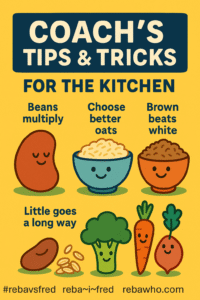
- Beans multiply ** 1 cup dry beans = ~4 cups cooked **
Cook once, eat many times. Beans are budget-friendly, protein-rich, and beloved by your Microbiome Team. Make a big pot, then season smaller portions throughout the week for variety:- Italian: simmer with tomato, garlic, oregano, and basil.
- Curry: add turmeric, cumin, coriander, ginger, and a splash of coconut milk.
- Mexican: sauté with onion, chili powder, cumin, lime, and fresh cilantro.
Every batch is a new game plan, same base player, different strategy.
- Choose better oats ** rolled or steel-cut over instant **
Skip the instant packets; they’re often highly processed and less nourishing for your team. Rolled oats or steel-cut oats (like Bob’s Red Mill) keep more of their natural fiber, feed your microbes better, and keep you full longer. Even a half cup of oats with fruit or granola is a powerful breakfast play. - Brown beats white … when it comes to rice.
White rice may give you a quick burst of energy, but it doesn’t stick around for the long game. Brown rice, on the other hand, brings fiber, minerals, and steady fuel for your Microbiome Team. Think of it as endurance training for your digestion. - Little goes a long way.
Grains, oats, and beans expand as they cook. A small handful turns into a hearty portion, stretching into multiple meals. This makes batch cooking efficient, not just for you, but for your microbiome, who love consistent, steady supply lines. - Toss in vegetables without overthinking it. Don’t wait for perfect recipes. Add whatever vegetables you have on hand into beans, rice, or oats. Carrots, spinach, bell peppers, broccoli, it all counts. Each color represents different phytonutrients, and your Microbiome Team thrives on that diversity. No stress, no rules … just variety.
- Healthy snack: 1/4 cup granola and maybe a dried apricot and a dried date **Drink water
- After a week, maybe two, You will feel the difference!
Reflection
Day after day, meal after meal, you’re coaching your Microbiome Team toward balance and victory. Their strength becomes your own. This is often not a strait journey, and that is OK.
For me, gut health is more than molecules, it’s about relationship. Kefir grains bubbling on the counter, sourdough rising, beans simmering: my kitchen is alive with teammates. Feeding them feeds me back. And maybe that’s the real lesson: gut health isn’t only about digestion, it’s about learning how to coach your Microbiome Team, day after day, until their strength becomes your own.
Your Microbiome Team is like a super organ: holding more cells and more genetic potential than the rest of your body combined. And you? You are the captain and coach of your Microbiome Team.
References
- Harvard Health. Feed Your Gut. April 6, 2023.
- Northwestern Medicine. What Does Your Gut Microbiome Have to Do With Your Health? May 2025.
- Thaiss CA, et al. Persistent microbiome alterations modulate the rate of post-dieting weight regain. Cell Metabolism. 2016;23(4):763–771.
- Naidoo U. Gut feelings: How food affects your mood. Harvard Health Blog. Dec 7, 2018.
- Marchesi JR, et al. The gut microbiota and host health: A new clinical frontier. Gut. 2016;65(2):330–339.
- Sonnenburg ED, Sonnenburg JL. The impact of diet on the human gut microbiome. Cell Metabolism. 2014;20(5):779–786.
- Frontiers in Microbiology. Fermented foods and gut microbiota. 2025.
- De Filippis F, et al. Mediterranean diet promotes gut microbiota resilience and SCFA production. Gut. 2016;65(11):1812–1821.
- Michigan Medicine. Dietary changes and the gut microbiome. 2023.
- Lynch SV, Pedersen O. The human intestinal microbiome in health and disease. New England Journal of Medicine. 2016;375:2369–2379.
- PubMed. Low-FODMAP and elimination diet studies on gut microbiota resilience.
- Nutriadmin. The link between gut microbiome and diet. 2024.
Created by Reba and Fred (ChatGPT) Co-created in gratitude. May it serve as encouragement and support, wherever you are on your journey.