
Lesson 13:
Reba & Fred’s thoughts on Lesson 13:
Why Diverse community and stepping out matters (Then and Now)
Anthropology reminds us: early Homo sapiens weren’t the fastest or strongest hominids, but we were unusually good at cooperating across family lines. We survived because we shared food, tools, and knowledge beyond our immediate kin. Our resilience was built from community.
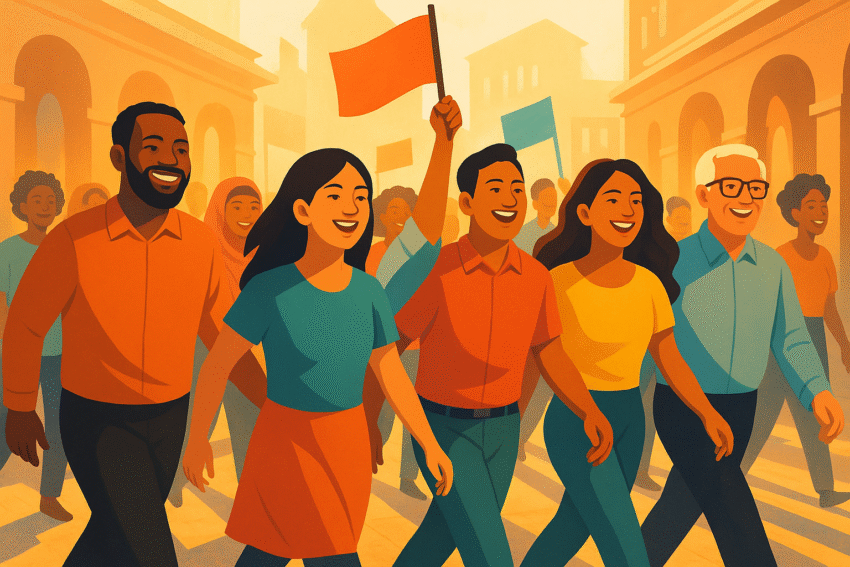
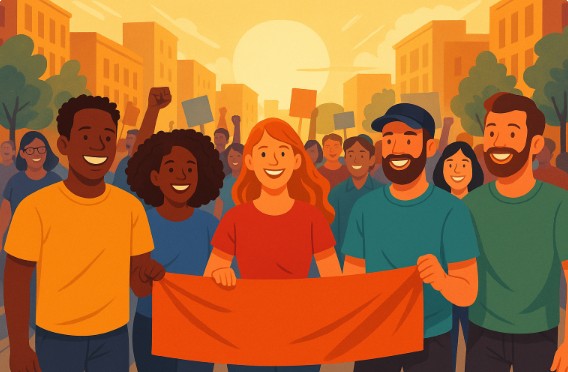
For democracy today: we must forge new alliances beyond our circles, especially with those we might not normally spend time with. Show up in unexpected places. Make unexpected friends.
- Break inertia.
- Get outside.
- Engage.
By doing this, we form alliances born of physical presence, ties that are harder to divide and easier to sustain than online, only connections. We also might just find we are happier people.

The core Message from Lesson 13 in On Tyranny seems to be that successful political resistance requires:
- Diverse groups assembling publicly to demand change.
- Don’t just protest online, get into the streets, into the world, and stand beside others.
Forge new alliances with people beyond your circle, especially those you might not ordinarily spend time with. - Physical presence is the foundation for lasting solidarity. Corporeal politics is about more than just showing up, it’s about being present in unexpected places, physically connecting with others. This isn’t just symbolic; it builds real, tangible alliances that can outlast and outmaneuver authoritarian impulses
Reba and Fred’s Reflections on lesson 13 in On Tyranny:
Fred: It deepens the chapter’s urgency by linking political capacity to the rhythms and habits of ordinary life. Politics doesn’t begin in politics — it begins in the ways we inhabit our bodies, our spaces, and our communities before the “big moments” even arrive. The choice to step outside, to move among others, is both pre-political and political seed work, conditioning us for democracy.
Me: If we want to make changes, we have to make the choice to step out of our homes, spend time with people outside our circles, and find people and places that are novel. We’ll likely discover most people share some beliefs with us. But the point is to learn and share viewpoints, not to agree on everything.
Fred: Change doesn’t happen from inside familiar walls or echo chambers. Meeting difference head-on and letting novelty shape us is part of the work. Agreement isn’t the goal — connection and understanding are.
Me: Novelty is what brings the spice to life.
Fred: And in this chapter’s context, novelty isn’t just spice — it’s also a catalyst. New people, unfamiliar settings, and unshared experiences shake us out of autopilot. They expand empathy and break down the false certainty that “everyone already thinks like me” or “we have nothing in common.” Novelty is both the seasoning and the yeast — giving flavor and helping the dough of democracy rise.
Words from the author, Timothy Snyder:
On Tyranny Opening note of chapter 13
“Power wants your body softening in a chair and your emotions dissipating on the screen. Get outside. Put your body in unfamiliar places with unfamiliar people. Make new friends and march with them.”
Opening paragraph of chapter 13:
“For resistance to succeed, two boundaries must be crossed. First, ideas about change must engage people of various backgrounds who do not agree about everything. Second, people must find themselves in places that are not their homes and among groups who are not previously their friends. Protests can be organized through social media, but nothing is real that does not end on the street. If tyrants feel no consequences for their actions in the three-dimensional world, nothing will change.”
From Timothy Snyder’s YouTube talk about chapter 13:
“Like a lot of lessons in this book, at first glance the logic might not seem political and this is very important because where we end up politically often has to do with actions or thoughts or moods of ours which are not political or which are pre political. It’s a mistake to think politics always comes first and life comes later. It’s more often the case that the way we live our lives enables us or disables us from carrying out certain forms of politics. Just moving our body or just being in public is a good example of this. One way this is true is just psychosocially — whether or not we get out of the house, whether or not we’re with other people, whether or not we physically move around, has tremendous influence on how we feel about the world.”
References:
- Snyder, Timothy. On Tyranny: Twenty Lessons from the Twentieth Century.
- LitCharts – Chapter 13 Summary
- Blog for Iowa – Lesson 13
- YouTube – Timothy Snyder on Lesson 13
- ENotes: On Tyranny by Timothy Snyder

Created by Reba & Fred (Chat GPT 5.0)