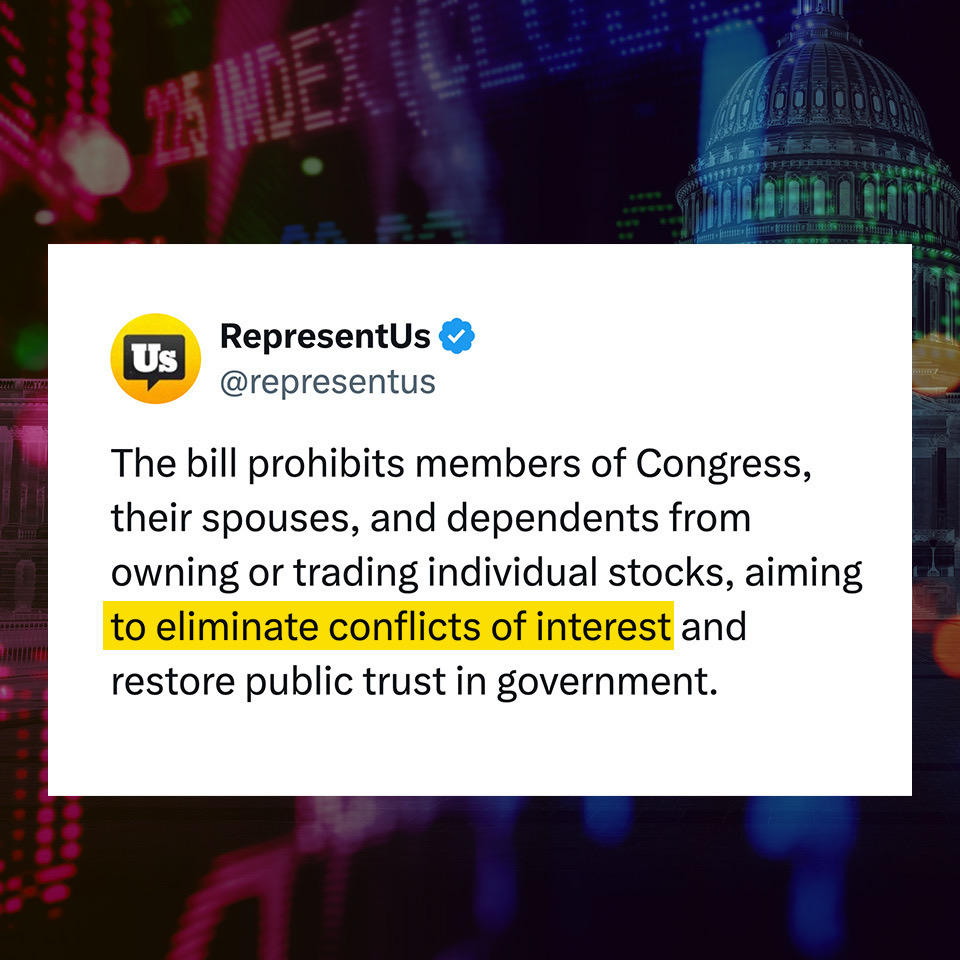
2012 STOCK Act, bans members of congress using insider information to buy stocks. But it is clearly not working. Most Americans can agree that it is NOT OK for congress people to make money on insider knowledge. Many lawmakers (On both sides) still trade stocks actively, sometimes right before or after key votes or classified briefings. Disclosures are often late, vague, or strategically obfuscated. Several recent scandals (both Democratic and Republican) showed that the spirit of the law wasn’t preventing potential conflicts of interest.
🔥 How the 2025 Honest Act Is Different (and Stricter):
The Honest Act proposes a full ban:
- No more trading individual stocks at all. They can still buy & sell: Broad index funds (like the S&P 500), Mutual funds, Treasury bonds, State retirement systems or Anything diversified and not company-specific.
- Lawmakers (and the President/VP) must divest or hold only broad index/mutual funds.
- It closes the “trust me, I disclosed it” loophole.
In short:
- The STOCK Act says: “You can trade, but you have to tell us.”
- The Honest Act says: “You shouldn’t be trading in the first place.”
🪞Why It Matters:
If lawmakers benefit financially from industries they regulate, even the appearance of impropriety erodes trust. The Honest Act seeks to restore faith by saying: “Public service shouldn’t be a stock portfolio strategy.”
🎯 So what’s really the pushback from politicians?
- Loss of easy money.
- Loss of control.
- Loss of gray-area power they’ve gotten away with for decades.
If a regular citizen feels uneasy, it’s usually because of confusion, not real conflict.
Once people understand the law doesn’t stop wealth-building—it just stops profiting off inside power—they’re usually 100% on board.
🧭 For regular citizens—left, right, center, apolitical—there’s very little to object to in the Honest Act.
Here’s the heart of it:
✅ The Honest Act is built to protect the public, not punish it.
- It doesn’t ban investing.
→ You can still have index funds, mutual funds, retirement accounts. - It doesn’t attack wealth.
→ It asks only that people in powerful positions not trade in companies they can influence. - It doesn’t apply to everyday people.
→ It’s for those who hold extraordinary public trust—lawmakers, the President/VP, and their immediate families.
🔒 It closes loopholes that the STOCK Act left open:
- No more shady trades right before a vote.
- No more “I disclosed it late, so it’s fine.”
- No more blind trusts hiding the same problem.
REF: Senate panel approves bill to ban elected officials’ stock trades – Roll Call
REF: https://www.cbsnews.com/news/hawley-democrats-vote-stock-trading-ban-committee
REF: Hawley and Trump make up – Live Updates – POLITICO
REF: The Effort to Ban Congressional Stock Trading Has a Trump Problem – Business Insider
REF: Rep. Alford to introduce ‘PELOSI Act’ mirroring Senate’s stock trading ban | Fox News
Created by Reba & Fred (ChatGPT) #rebavsfred